Heritage texts, typology and human history in the Southern Cone

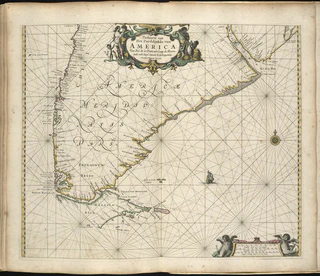 A map of the Southern Cone, from Pieter Goos, 1672. Norman B. Leventhal Map & Education Centre, Boston Public Library.
In July 2025, I was awarded a 4-year Leverhulme Research Grant for the project “Texts, typology, and language history in the Southern Cone: A digital framework”. The research, focusing on language filiation, contact and change in some 30 languages, will be conducted by an 8-person team in Scotland, Chile and Argentina.
The Americas were the last continental mass to be populated by humans, who would have crossed via the Bering Strait and migrated southward following the last Ice Age, reaching Tierra del Fuego quickly thereafter. Despite this, genetic, archaeological and linguistic data seem to suggest that populations of the Southern Cone remained fairly isolated. In linguistic terms, this is reflected by the lower density of languages, and the absence of large families, as compared, for instance, to the Amazon and Gran Chaco zones immediately to the north. In fact, current descriptions of the Patagonia and Tierra del Fuego tend to find only smaller language families (like Chon or Huarpean) alongside numerous isolates – languages with no known relatives. Such descriptions, however, are based on minimal, poorly contextualised data. Our team’s efforts to gather and carefully annotate the linguistic materials should allow for a re-assessment of these claims with the best data available, establishing shared words, sounds and grammatical patterns which may point to links within and outside the area, thus probing isolationist theories.
Crucially, the project will bring together archival materials which have been difficult to access heretofore, creating a digital repository with abundant linguistic and contextual annotations. This resource, the Comparative-Historical Corpus of the Southern Cone (CHiCo-SC), will be available to researches as well as native communities, most of which no longer speak their heritage language.
While much of the early textual material from the Americas is problematic due to the interference of non-native writers, the prevalence of scholastic grammars, genre limitations, etc., there is no doubt that such materials represent versions of the Native American languages which must be squared with reconstructions based on current varieties.
